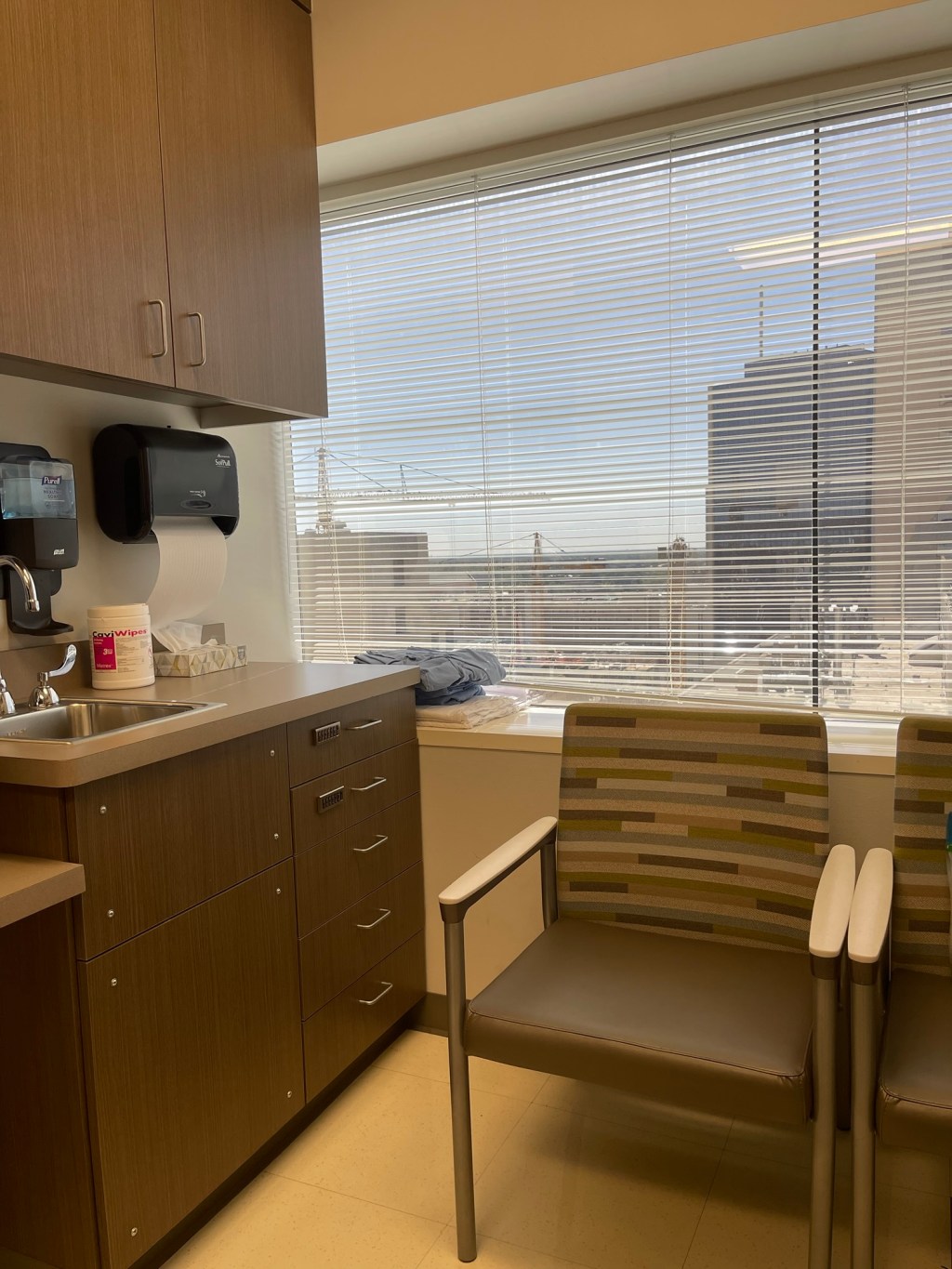
Today was a big day. I had my follow-up appointment with my breast surgeon to discuss surgery after completing most of my neoadjuvant therapy. Sitting in that office today, I felt the weight of every appointment, every infusion, every scan that led me here.
The surgeon reviewed my chart, imaging, and the journey so far. It’s wild to think back to October when I was first diagnosed with HER2-positive, ER/PR-negative, grade 3 invasive ductal carcinoma. I was originally seen for a right breast issue, but an MRI revealed an entirely different problem on the left side. Since then, I’ve been receiving neoadjuvant therapy, which is treatment like chemotherapy or targeted therapy given before surgery to shrink the tumor and kill cancer cells early. It’s been tough, but today I found out that it’s been working.
The surgeon examined me carefully. “I can’t feel a mass,” she said. Hearing those words made me feel something I hadn’t let myself feel in a while: hope. She couldn’t feel the lump, and the lymph nodes that were once large and abnormal have now shrunk.
She talked me through the next steps. Because I’ve responded well, she’s recommending breast-conserving surgery—a lumpectomy with wire localization. This means they’ll use a small wire to guide the surgeon directly to the area where the tumor was, so they can remove it while preserving as much healthy breast tissue as possible.
As for my lymph nodes, the plan is to do a targeted axillary lymph node biopsy. Earlier in my diagnosis, a marker was placed in the lymph node that tested positive for cancer. Now, the surgeon will go in and remove that specific node to see if there’s any cancer left. This approach is less invasive than removing a bunch of lymph nodes, which I learned is called a full axillary lymph node dissection—where many or all lymph nodes are removed to check for spread. A full dissection carries more risks, like swelling or lymphedema, so avoiding it if possible is a huge win. But she was clear: if cancer is still found in the nodes during surgery, they may need to proceed with a full dissection right then and there.
It’s a lot to take in. Knowing they’re literally going inside to remove what once threatened my life feels both empowering and terrifying. I’ve had markers in my breast all this time to guide the team back to where the cancer started. I remember the pain when they inserted them, but I didn’t stop them. I couldn’t. This is their job, and I knew it was necessary to help save my life.
After the appointment, I sat in my car and reread the notes in my patient portal. Seeing “excellent response to treatment” made me a little emotional. It also reminded me that this journey isn’t over. Surgery is next, and with it comes another set of challenges and unknowns.
Today’s highlight? Hearing that the mass is no longer palpable. Hearing that the lymph nodes are shrinking. Hearing that the plan is working.
It’s not the end of the road, but it’s a major milestone—and for today, that’s enough.
 Practicing Medicine
Leave a comment